
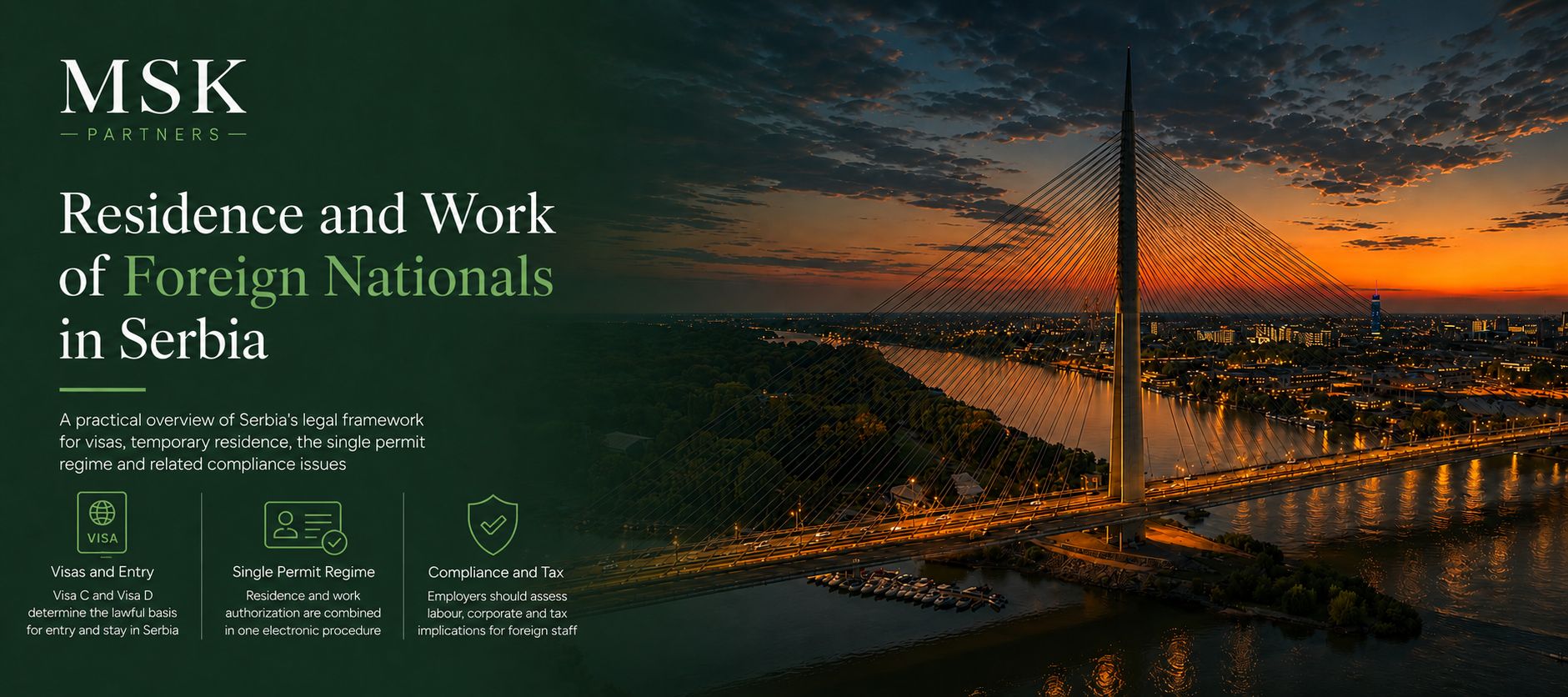
Serbia as a Destination for Foreign Workers and Investors: Work Permit, Residence and Compliance
In recent years, Serbia has recorded a continuous increase in the number of foreign nationals entering the country for the purposes of employment, conducting business, investment and long-term settlement. At the same time, companies operating in the Serbian market are increasingly faced with the need to engage foreign experts, members of management bodies, posted employees and other internationally mobile personnel. For these companies, understanding the work permit requirements in Serbia and structuring the employment and residence status of foreign nationals correctly is no longer an administrative formality.
In such an environment, the proper regulation of the status of foreign nationals becomes an important matter of regulatory compliance, human resources planning and the implementation of international business projects.
Against the backdrop of strong demand for labour in the construction, IT, industrial, transport, hospitality and tourism sectors, the Republic of Serbia is becoming not only a transit country, but also a destination country for foreign workers and investors.
For the state, opening the labour market brings tangible economic benefits, but also entails an obligation to strike an appropriate balance – to protect the domestic labour market and ensure the equal treatment of domestic and foreign workers, to combat undeclared work and exploitation, while at the same time providing swift, transparent and digitalised procedures. A significant step in that direction was taken through the amendments to the Law on Foreigners and the Law on the Employment of Foreigners, which became applicable on 1 February 2024 and introduced the system of a single permit for residence and work.
Despite the modernisation of the legal framework over the past two years, in practice the immigration status of foreign nationals remains one of the most common sources of legal and operational risk for employers and investors in Serbia.
Legal and Institutional Framework
The status of foreign nationals is governed primarily by the Constitution of the Republic of Serbia, the Law on Foreigners, the Law on the Employment of Foreigners, the Law on Citizenship of the Republic of Serbia and the Labour Law, as well as by ratified international treaties. The key authorities responsible for implementing these regulations are the Ministry of Foreign Affairs (through diplomatic and consular missions), the Ministry of the Interior and its organisational unit responsible for foreign nationals, and the National Employment Service.
Before planning an arrival, the first practical step is to determine whether the foreign national is subject to a visa regime or may enter visa-free, as this determines the entire procedure for entry and the regulation of residence.
Visas: Visa C and Visa D
A visa does not constitute permanent status or lead to citizenship; rather, it enables lawful entry into and stay in Serbia. In practice, the following two types are the most relevant:
- Visa C (short stay) permits a stay of up to 90 days within any 180-day period, with the possibility of multiple entries. It is used for tourist, business and private visits and, as a rule, may not serve as the basis for temporary residence;
- Visa D (long stay) is issued for a period of 90 to 180 days and is intended for foreign nationals subject to a visa requirement who intend to regulate temporary residence or obtain a single permit. A Visa D issued on the grounds of employment may itself constitute the legal basis for work in Serbia during its period of validity (up to 180 days), without a separate single permit, which is useful for shorter, project-based engagements. The possibility of working depends on the specific grounds on which the visa was issued and requires an assessment in each individual case. It should also be borne in mind that, where a Visa D is required for entry, an application for a single permit may be submitted only during the validity of that visa and on the same legal grounds on which the visa was issued.
Temporary Residence and the Single Permit for Residence and Work
Temporary residence changes the status of a foreign national from that of a visitor to that of a person lawfully and continuously residing in Serbia. Temporary residence may be granted on various grounds, including work, education, family reunification, ownership of immovable property and other grounds prescribed by law.
The Single Permit for Residence and Work
The single permit for residence and work is the most important legal instrument for foreign workers. As of 1 February 2024, the amendments to the Law on Foreigners and the Law on the Employment of Foreigners (adopted in 2023 and aligned with EU law, primarily Directive 2011/98/EU) merged the two previous procedures – approval of temporary residence and issuance of a work permit – into a single procedure. The single work permit for residence on work-related grounds (employment, self-employment, posted persons, intra-company transfer, independent professional activities, training and professional development), is valid for up to three years and may be extended.
For the business community, the following changes are of the greatest practical importance: the application is submitted exclusively electronically through the Portal for Foreigners and may also be submitted by the employer on behalf of the foreign national; the permit is issued in the form of a biometric card, replacing the former passport stickers; and the procedure is designed to ensure significantly shorter decision-making timeframes. The single permit enables a foreign national to lawfully reside and work in the Republic of Serbia within the approved grounds, with access to the rights and obligations arising under employment law and the compulsory social insurance system.
Of particular importance to employers is the fact that engaging a foreign national without an appropriate legal basis for work may result in liability for a misdemeanour and substantial fines. Accordingly, immigration compliance in Serbia is now regarded as part of the broader system of regulatory compliance.
A Frequently Misunderstood Situation: The Foreign Director
A particularly relevant practical issue is the engagement of a foreign director or representative of a company. As a rule, a representative of a company registered in the Republic of Serbia is not required to obtain a single permit if he or she will not remain in Serbia for more than 90 days within a 180-day period and will not enter into an employment relationship with that company (but is instead engaged under a management agreement). Once the director enters into an employment relationship or exceeds the stated residence threshold, a single permit becomes mandatory.
In addition to immigration matters, due consideration must also be given to the potential tax implications of a foreign national’s longer-term stay in Serbia. Depending on the specific circumstances, including the location of the centre of the individual’s personal and business interests, the foreign national may acquire the status of a tax resident of the Republic of Serbia, which requires a separate analysis in each individual case.
In practice, an improperly structured basis for residence and work often results in delays to the commencement of work or the rejection of an application.This question arises regularly in the context of company formation and corporate governance in Serbia and should not be approached as a routine administrative choice.
Tax Residency: A Parallel Consideration
In addition to immigration matters, due consideration must be given to the potential tax implications of a foreign national’s longer-term stay in Serbia. Depending on the specific circumstances, including the location of the centre of the individual’s personal and business interests, the foreign national may acquire the status of a Serbian tax resident which requires a separate analysis in each individual case and materially affects the overall costs of doing business.
In practice, an improperly structured basis for residence and work often results in delays to the commencement of work or the rejection of an application.
Permanent Residence
Permanent residence represents the highest degree of integration of a foreign national without the acquisition of citizenship. As a rule, it is granted after at least three years of prior continuous residence on the basis of temporary residence or a single permit (the reform reduced this requirement from five to three years), subject to the fulfilment of other conditions prescribed by law. Persons granted permanent residence are issued an appropriate identification document in accordance with the regulations of the Republic of Serbia.
Citizenship of the Republic of Serbia
The acquisition of citizenship establishes a permanent constitutional and legal relationship between the individual and the state and entails all rights arising therefrom, including the right to vote, constitutional protection and the right to a Serbian passport.
The Law on Citizenship of the Republic of Serbia provides for four methods of acquiring citizenship: by descent, by birth in the territory of the Republic of Serbia, by admission (naturalisation), and pursuant to international treaties. In practice, citizenship is most commonly acquired by admission (naturalisation), with the specific requirements depending on the grounds on which the application is submitted. In addition to the general naturalisation regime, the law also provides specific grounds for the admission of certain categories of persons, which is why it is necessary in each individual case to determine which regime is the most favourable. This assessment is typically conducted as part of a broader private wealth and relocation planning process.
Practical Challenges and the Direction of Reform
Although the regulatory framework has been significantly modernised through the introduction of the single permit, practice shows that administrative efficiency continues to vary and that overlapping competences among different authorities may create operational delays. Steps towards full digitalisation, such as the welcometoserbia.gov.rs portal, facilitate access to information but do not resolve the complexity of individual cases.
For international companies and corporate groups establishing a presence in Serbia through foreign direct investment, the successful relocation of employees or appointment of foreign directors requires a coordinated and timely assessment of three key aspects:
- Employment-law status — The proper structuring of employment agreements, management agreements, or employee posting and relocation documentation.
- Tax implications — Assessment of the risk that a foreign national acquires the status of a Serbian tax resident.
- Corporate compliance — Prevention of liability for misdemeanours and substantial fines arising from engaging persons without an appropriate legal basis. This dimension connects directly to corporate governance and regulatory compliance obligations of the employing entity.
Conclusion
The legal status of foreign nationals in the Republic of Serbia is today a dynamic field in which immigration policy, employment law and economic development intersect. For foreign investors and domestic employers, properly structuring this status is no longer an administrative formality, but a strategic matter of managing legal and business risks.
Timely legal analysis and preventive planning ensure not only the successful implementation of investment projects, but also the necessary predictability of business operations in an increasingly complex international environment.